Travel: Maldives – A Paradise on the Indian Ocean

By Saptarshi Kundu
One Sunday morning, I got an email form my fiancée (now wife) about an island called Bora Bora in the French Polynesia. Her favourite pass-time is searching for tiny islands in Google earth, and whenever she finds something interesting, she shares with me. The pictures of Bora Bora looked stunning with the blue sky, turquoise water, white sand, green mountains, and lots of tropical flower. It was like the heaven on earth. It was three months before our wedding; we had some time to plan for our honeymoon in this picturesque destination.
I am always in the habit of planning very extensively and meticulously, making others bored. This tour was no exception. However, the only problem seemed to be the distance from India. To reach the island of Bora Bora, we had to cover almost half the earth. The sky-rocketing air-fare made me think twice.
Instead, I searched and found Maldives, comparable to the island in Tahiti. The more I read about Maldives, the more loved it.
About Maldives
Both Bora Bora and Maldives are on the base of coral reefs and both are in the tropical region. However, there are two major differences: there are no mountains in Maldives; and, unlike, Bora Bora, Maldives is not a single island but a cluster of hundreds of islands.
Some of these islands are so tiny that you could hop on the other side with a couple of long steps. Most of them are ring-shaped (sometimes not a full ring, as the coral reef is broken). Some of them are completely immersed in the water. Scientists are worried about the rising sea level; they feel the islands might be under water by 2100. The average area of the islands is only about 1-2 square kilometres, and lie between one and 1.5 meters above the mean sea level. This makes Maldives the flattest country in the world.

Maldives, the flattest country in the world
Most of the islands are covered in greenery: the flora and fauna include coconut, banana, papaya trees, and many tropical flowers. Mangroves are found naturally. Generally, you don’t find big trees, but, to our surprise, we found a huge banyan tree in our island resort.
Maldives is known for its variety of colourful fishes, and it’s easy to spot them in the crystal clear water. After tourism, fishing is the second major economic activity.
When to Go
The temperature in Maldives ranges between 24°C and 33°C throughout the year. As it has a tropical climate with a bright sun and a pleasant see-breeze, the humidity is relatively high. It has two seasons, the dry north-eastern monsoon from December to March, and the wet south-western monsoon from May to November, with stronger winds and rain.
We travelled at the end of July, and after our arrival at Male airport we had to wait for 1.5 hrs for sea plane transfer, as there was a rain with strong wind. However, barring a single day, which was a little cloudy, we enjoyed sunny tropical weather during the rest of our stay.
There is no bad time to visit the Maldives, but during holidays, especially year-end holidays, the price shoots up, due to the high volume of European holiday tourists. Read more about the climate here.
Getting There
Every tourist gets on-entry 30 days hassle-free tourist visa and, at the entry point, you have to carry only the passport.
Male is the international airport for Maldives, and it is connected with India, Sri Lanka, and most of the European countries by air. As your aircraft descends, you can’t miss the hundreds of ring-shaped islands that make for an out-of-the-world spectacular aerial view.
For transfer to your resort (generally included in the booking), you will have two options depending on the distance between your resort and the international airport: speed boat for nearer destination, and the sea-plane for the far ones. For more information on getting there and around, see here.

Hundreds of ring-shaped islands make for an out-of-the-world, spectacular aerial view
Where to stay
The most difficult job is choosing your accommodation. Each resort is built on a single island and each one is unique, offering most of the amenities. Since the islands are surrounded by blue water, there is no easy means of transportation. As I have always been fascinated by sea-planes, we chose a resort which was a little far from the Male International Airport and availed sea plane transfer both ways. It was a spectacular and unique experience.

Sea plane transfer, a unique experience
There are different accommodation facilities available, starting from beach-houses to over-water bungalows. Almost every resort offers these variations. Since my wife was excited about staying in an over-water bungalow, we booked one. It was the most magical, spectacular, and romantic experience. We could spot colourful fishes from our couch during daytime. In the afternoons/nights, we usually sat on the deck with a glass of wine.

Over-water bungalows are really stunning
Maldives is a luxury tourist destination. Owing to the scarcity of natural resources, like drinking water and vegetation, food is costlier. It might be a better idea to go for an ‘all inclusive’ package, which enabled us to just relax and enjoy our food under the natural shade of coconut trees. As our resort had five main restaurants, offering cuisines from different places, we enjoyed the change of taste and location.

We enjoyed our food under the natural shade of coconut trees

Time to sit and have a drink by the side of the lagoon
Nights are more magical, romantic, and relaxing. After dinner, we usually took a stroll near the water.
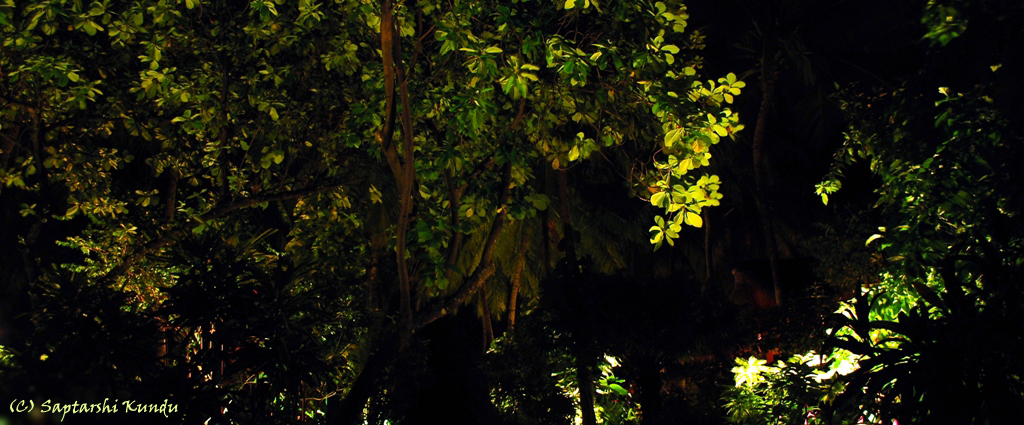
Nights are more magical and romantic
Things to do
You can relax and unwind your body and mind with the help of good food. You might choose to photograph the tropical weather and the picturesque surroundings. Most people prefer to have a sun-bath, read books, listen to music lying in the hammock, or just sit idle under the tropical trees on the white sand, enjoying the surrounding beauty.

Best pass-time is just sitting idle under the tropical tree on the white sand
Maldives is one of the most beautiful coral islands, having plenty of colourful fishes and corals. Since snorkelling is a favourite pass-time here, almost all the resorts let out snorkelling equipment. And if you are a photography fanatic like me, you can try snorkelling with an underwater camera. You might have to carry your own camera for this.
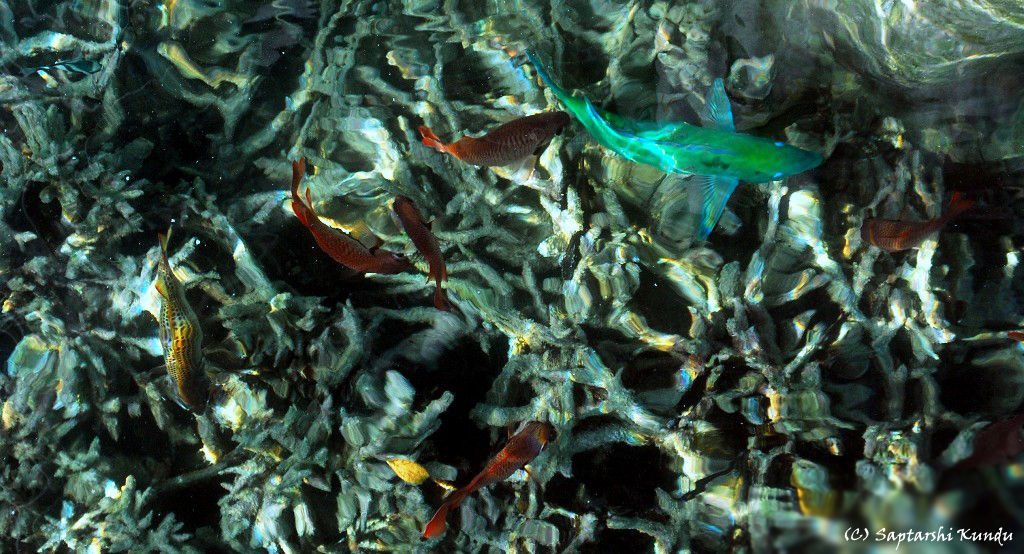
Best place for snorkelling: plenty of colourful fishes and corals
Maldives is considered a paradise for divers because of its rich sea life. Our island had a diving school, where you could learn, if you had enough time. You could also enrol for big fishing. We refrained from fishing as we didn’t find it to be very compatible with our honeymooning frame of mind.
Sometimes resorts arrange for local island visits, where you can buy home interiors like corals. You can choose to go for a dolphin cruise, where you will experience the magical sunset, spot a few dolphins and, sometimes, a school of flying fishes. To top it all, we were served chilled champagne on the boat!
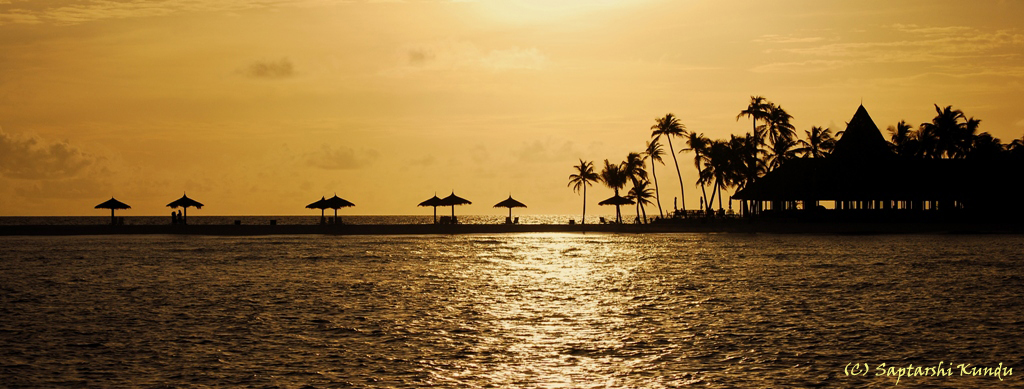
The sunset looked magical from the cruise.
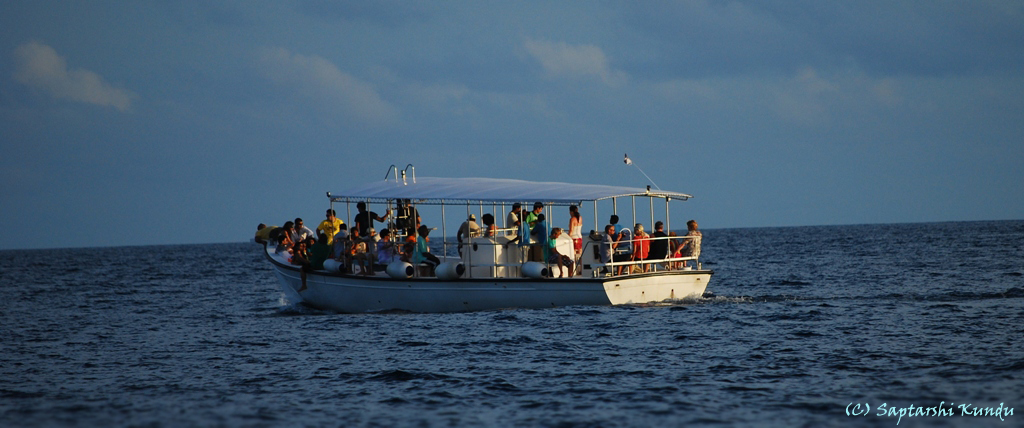
Boat ride for dolphin-spotting
Next time, you think of getting away from the drudgery of daily life, think of Maldives!
[Saptarshi Kundu is a software engineer, currently working with the Tata Consultancy Services, Mumbai. He is passionate about traveling and is a photography fanatic.]
[Cafe Dissensus Everyday is the blog of Cafe Dissensus magazine, based in New York City, USA. All materials on the site are protected under Creative Commons License. Once a piece is published in Cafe Dissensus Everyday, we will retain exclusive copyright for a period of 15 days, from the date of publication. Within this period, the piece cannot be re-published elsewhere even in an adapted and modified form.Thereafter, it must be acknowledged that the piece was first published in Cafe Dissensus Everyday. Failing to comply with this and any unauthorized republication/reproduction of the piece will invite legal measures and will be liable to prosecution.]
 Cafe Dissensus Everyday
Leave a comment